



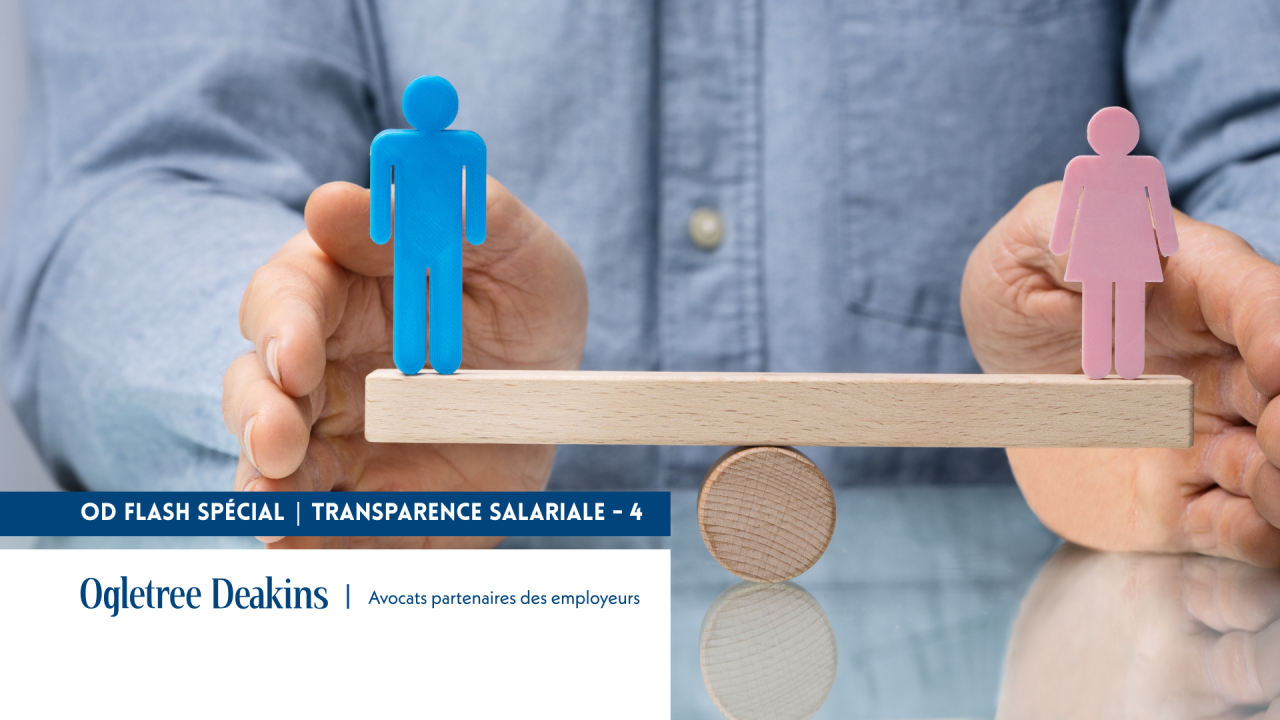
On March 6, 2026, the Ministry of Labor transmitted to national union and employer’s associations representatives and members of parliament a first draft of the bill to transpose Directive (EU) No. 2023/970 of May 10, 2023, on pay transparency into French law.
This update (4/5) is part of a series dedicated to the main measures provided for in this draft law, the various components of which will be presented in succession.
New criteria for assessing “work of equal value”
The employer is required to ensure equal pay between women and men “for the same work or work of equal value.” In this regard, Article 4.4 of Directive (EU) No. 2023/970 provides for a weighting method based on objective, non-sexist criteria, including: “skills, effort, responsibilities, and working conditions, as well as, where applicable, any other factors relevant to the job or position concerned.”
To date, the Labor Code defines work of equal value as “work that requires employees to possess a comparable set of professional knowledge attested by a degree, diploma, or professional practice, skills derived from acquired experience, responsibilities, and physical or mental strain” (Article L. 3221-4 of the Labor Code).
To comply with the Directive (EU) No. 2023/970, the draft law now provides for the addition of two new criteria for assessing whether work is of equal value, namely: non-technical skills and working conditions.
As part of the implementation of indicators regarding the gender pay gap, the bill further provides that companies must be covered by a document establishing the categories of employees performing work of equal value, according to the criteria outlined above. The document determining this categorization may be:
– a company-level agreement;
– in the absence of such an agreement, a sector-wide agreement, although an agreement at this level is not mandatory (New Article L. 2241-11 of the Labor Code). The sector-wide agreement must, where applicable, specify the period—which may not be less than six months—after which it takes effect following its conclusion.
– In the absence of any applicable collective agreement, the employer may proceed with the categorization by unilateral decision after consulting the social and economic committee (New Article L. 3221-4-1 of the Labor Code). This unilateral decision may be implemented for a period of three years.
This categorization will allow:
– calculating Indicator 7 of the new index corresponding to the pay gap between women and men by category grouping employees performing work of equal value or of equal worth
– determining whether negotiations must be initiated to establish measures aimed at reducing the gap observed in one of the categories in companies with 50 to 99 employees
– in companies with 100 or more employees, justifying this gap or to remedy such a gap within six months following the first publication of the index, through a collective agreement or a unilateral decision regarding appropriate and relevant corrective measures
– and finally, complying with employees’ right to information regarding their pay levels and the average pay levels, broken down by gender, of employees in the same category. However, the employer will not be required to provide this information if the company falls into a category with fewer than a certain number of employees, as determined by decree. According to the latest information provided by the Ministry, this threshold would be set at 10 employees.
Entry into force: In the absence of any specific provision in the draft law, these new provisions regarding the categorization of employees would enter into force upon the promulgation of the draft law. According to the latest information provided by the Ministry, the draft bill is expected to be presented to Parliament at the end of May.